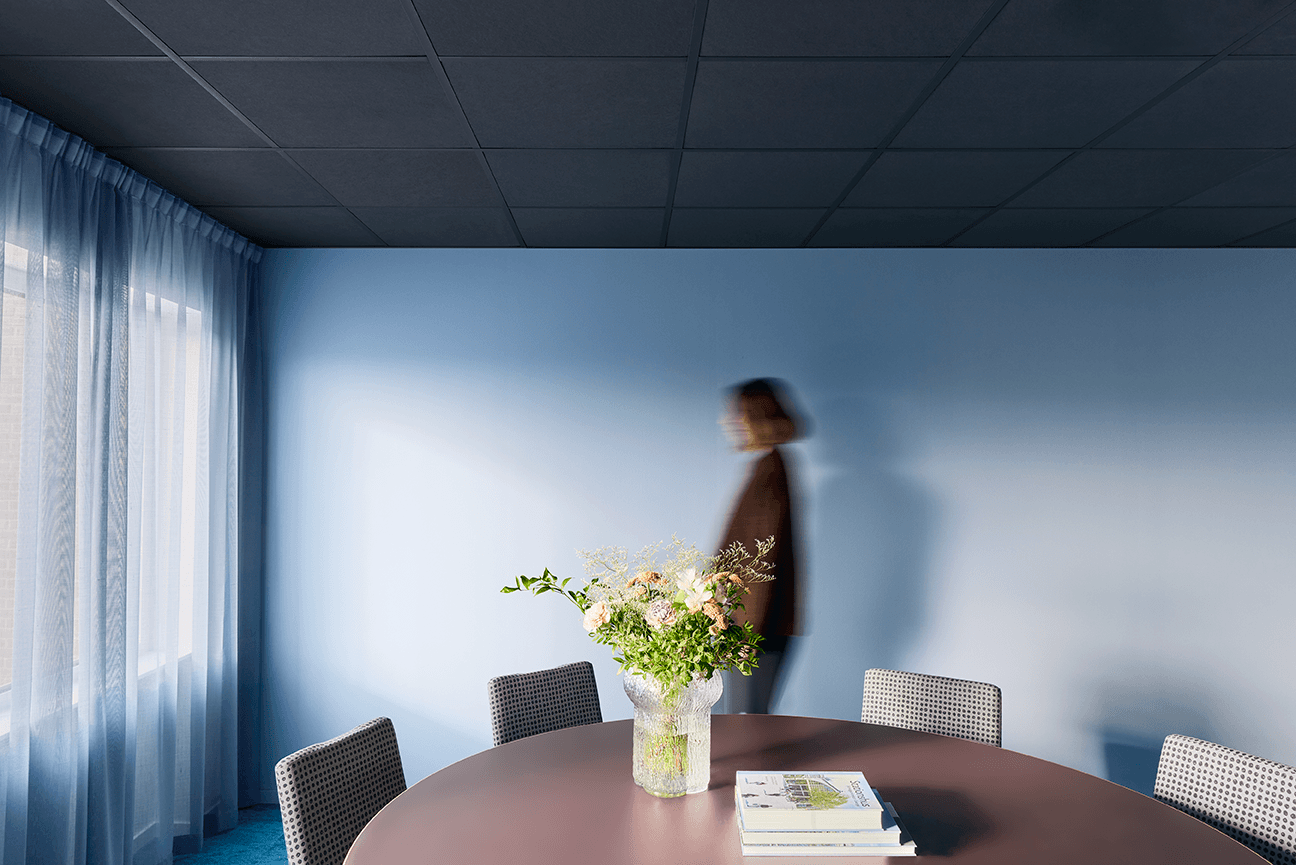
Aisti Aalto®.
Wood fibre, foam-formed without plastic or mineral binders. Class A absorption in the standard grid build-up, B-s1,d0 fire classification, M1 and French A+ for indoor air. It goes into the same T-grid, with the same trades, as the tile it replaces.
A conscious choice
Specify it on
the spec sheet.
Aisti Aalto is a bio-based absorber built for real projects, not for a sustainability appendix. The fibre is chemi-thermomechanical spruce pulp from certified Finnish forests, foam-formed without plastic, mineral binders or irritating fibres. It is declared to EN 13964:2014 — the same harmonised standard as the mineral wool tile beside it — carries a 50-year reference service life, and Aisti prices it without a green premium. Nothing about specifying it asks you to argue from goodwill.
The technology
Bound by hydrogen,
not by plastic.
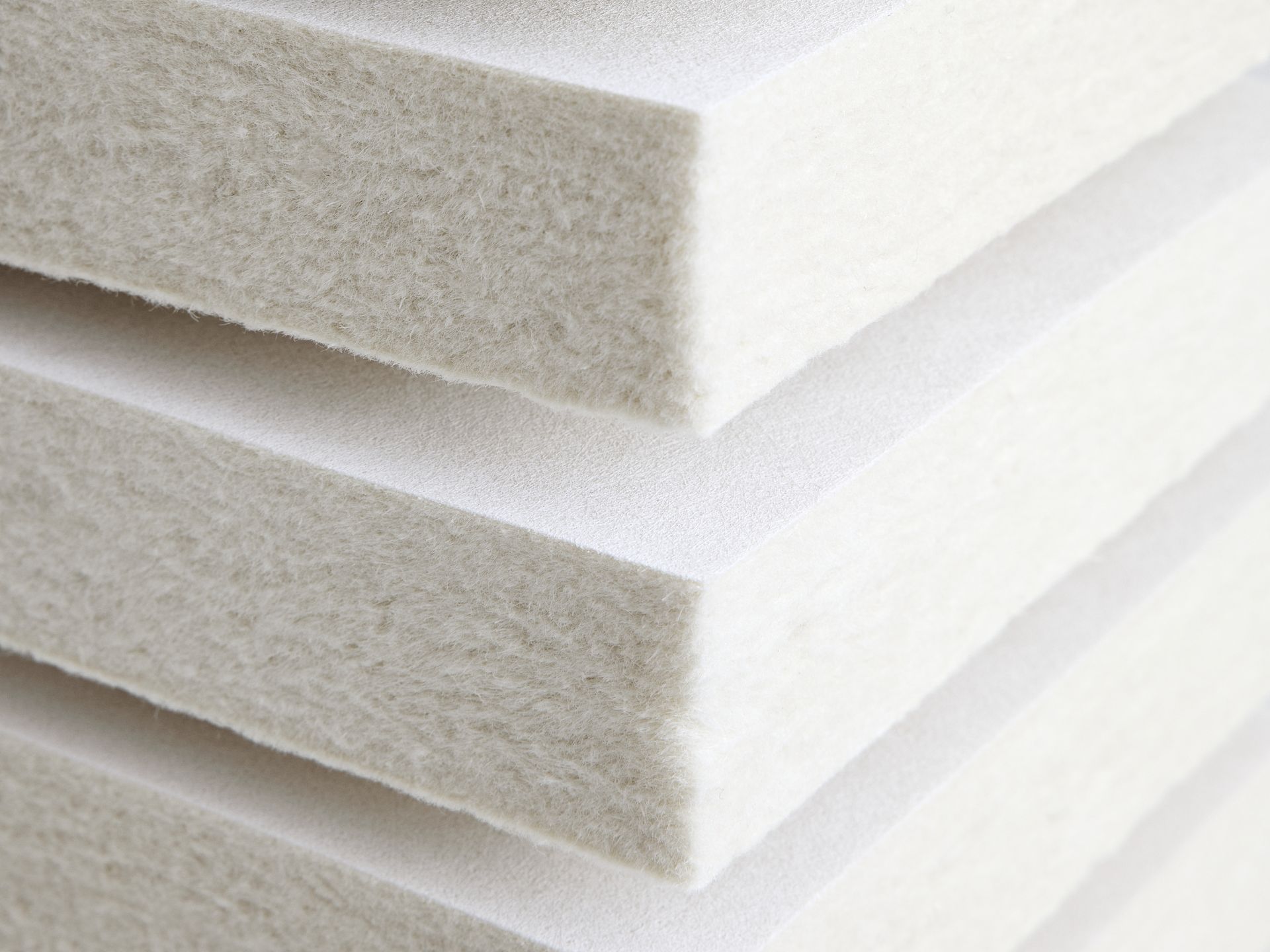
It starts as spruce. The fibres are pulped, then mixed with water and a foaming agent so that millions of tiny bubbles carry them — the foam spreads the fibre evenly and leaves an open, porous structure that absorbs sound across a wide frequency range. As the mixture dries, natural hydrogen bonds form and hold that structure together, which is why the tile needs no plastic or synthetic binders. The tiles are moulded from that material.
Fire protection sits in the material, not in a coating. A potassium-based salt treatment reacts to heat and forms a protective ceramic layer on the surface of the tile — a barrier that shields the wood fibres beneath and slows flame spread, which is what carries the B-s1,d0 classification. The solution is patented and unique to Aisti. At end of life the core goes back to the factory to be pulped and formed again. Made in Finland.
In the room that reads as less reverberation and less background noise. Speech carries, conversation stops competing with the ceiling, and the space is easier to be in for a day.
The partner
It started with
a ceiling fitter.
Aisti began with a question from one of Mikko Paananen's clients: was there a more sustainable ceiling tile that gave up nothing on performance or cost? He was running a ceiling installation company at the time and could not find one. The search led him to foam-forming — a fibre process that had been researched for acoustics but never taken to production. Manufacturing moves from the pilot line to a plant in Kitee during 2026, on a contracted mix of 70% nuclear and 30% hydro power.
In place
Aisti gallery
Formats
Explore our edge types
Aisti Aalto tiles are available in three edge profiles — A, B, and E — each offering a distinct aesthetic and installation method to suit your project.
Performance
Aisti® — four configurations.
(Material thickness / Installation height)
Hover a line, or click to lock.
EN ISO 354 reverberation room. Plate thickness / air gap (mm). α ≥ 0.90 across speech bands qualifies as Class A.
Format
600 × 600 mm
1200 × 600 mm
Fits standard T-grid systems.
Thickness
20 mm
40 mm
20 mm and 40 mm, both in either format. Mounting is set by the edge profile, not the thickness.
Material & life
Video
The film,
in place.
CO₂ savings
Aisti Aalto,
by the numbers.
Ceiling area
150 m²
Aisti Aalto 20 mmProduction stage, A1–A3 (GWP-fossil)
0
Aisti Aalto 20 mmCarbon held in the fibre to the factory gate
0
Rockfon Sonar 20 mmStone wool, A edge · production stage, A1–A3
0
0 kg
Less carbon to the factory gate than Rockfon Sonar 20mm
Both figures are each manufacturer's own published production-stage number, A1–A3, for a 20 mm tile on a T-grid edge. Aisti Aalto: 1.29 kg CO₂e/m² GWP-fossil, EPD Hub HUB-5632 (published 06.03.2026) — a design-phase EPD, from a test line, ahead of the Kitee plant. Rockfon Sonar: 2.29 kg CO₂e/m², A edge, datasheet 09.2024. The 3.09 kg CO₂e/m² of biogenic carbon in the Aisti tile is held for the life of the ceiling and returns at end of life under the EPD's disposal scenario, so it is shown but not counted as a saving. Rockfon note that impact values are generally not directly comparable between manufacturers; treat this as an order of magnitude, not a certificate.
Aisti Aalto
Our tilevs